3dom
3D Object Model
jQuery for 3D. Address and edit any three.js scene with CSS-like selectors, deterministic auto-labelling, and undoable ops. All in one line:
$S('.wheel').recolor('#111').scale(1.2);
$S.undo();
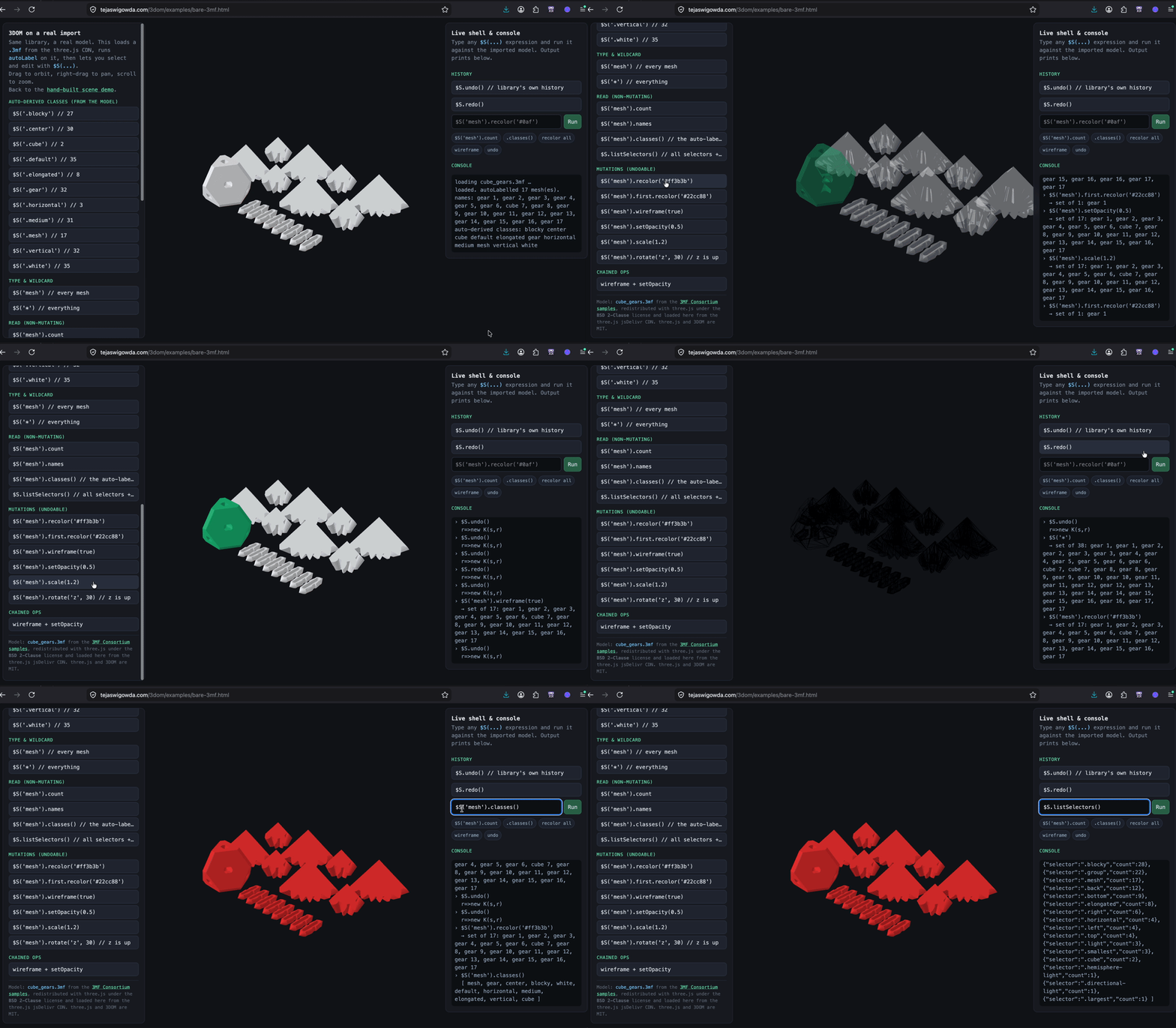
No editor. No framework. No build step required. Just three.js (a peer dependency) and this.
▶ Repository: http://tejaswigowda.com/3dom/
▶ Spec: https://github.com/tejaswigowda/3dom/blob/main/SPEC.md
▶ Live demo: bare.html · bare-3mf.html
Features
◆ Selectors: Query the scene graph like the DOM: mesh, .red, #Body, .wheel:visible, light, camera.
◆ Auto-labelling: Derive stable classes from geometry, colour, material and name. So .red, .box, .wheel just work on scenes you didn’t author.
◆ Undoable ops: Every mutation goes through a Host. Out of the box you get a built-in undo/redo stack. Drop in your app’s command system to reuse it.
◆ Tiny: ~24 kB minified. three.js stays external.
Installation
Straight from a CDN. No build, no publish step. jsDelivr serves the repository’s dist/ directly from GitHub. three is a peer dependency, so include it via the same import map.
Copy this into your page’s <head>:
<script type="importmap">
{ "imports": {
  "three": "https://cdn.jsdelivr.net/gh/mrdoob/three.js@r160/build/three.module.js",
  "@tejaswigowda/3dom": "https://cdn.jsdelivr.net/gh/tejaswigowda/3dom@v1.0.0/dist/3dom.esm.min.js"
} }
</script>
<script type="module">
  import { createS, autoLabel } from '@tejaswigowda/3dom';
  // autoLabel(scene); const $S = createS(scene);
</script>
Pinned to a tag (as above) for an immutable, long-cached URL. @main also resolves but is mutable and cached for up to a week. Alternative CDNs use the same path shape:
jsDelivr:
https://cdn.jsdelivr.net/gh/tejaswigowda/3dom@v1.0.0/dist/3dom.esm.min.js
Statically:
https://cdn.statically.io/gh/tejaswigowda/3dom/v1.0.0/dist/3dom.esm.min.js
Note: Strata editor consumes this library exactly this way. Its import map maps
@tejaswigowda/3domto the pinned jsDelivr URL, thenstrata3dom.jsimports it by bare specifier.
Quick Start
Here’s a 60-second example using bare three.js:
import * as THREE from 'three';
import { createS, autoLabel } from '@tejaswigowda/3dom';

const scene = new THREE.Scene();
// ... add your meshes ...

autoLabel( scene );            // derive .red / .box / .wheel / … classes
const $S = createS( scene );   // bind selector, with its own undo history

$S('.wheel').recolor('#ff3b3b').scale(1.2);
$S('mesh').rotate('y', 30);
$S('.roof').setVisible(false);

$S.undo();   // built-in, reversible
$S.redo();

$S.listSelectors();  // [{ selector: '.wheel', count: 4 }, …]
Live demo: Open bare.html, orbit/pan/zoom the scene, click selectors and ops, and type your own $S(...) commands in the live shell. Source: examples/bare.html. No editor, no bundler required.
Selectors
Query the scene graph using familiar CSS-like syntax:
| Selector | Matches |
|---|---|
mesh light … |
By object type: mesh, group, light, camera, sprite, line, points, bone, object3d |
.red .wheel |
By class (author-set or auto-labelled) |
#Body |
By id: userData.label, falling back to .name |
.a.b |
Compound (AND) |
A B |
Descendant combinator |
A > B |
Child combinator |
* |
All objects |
:selected |
Host app’s live selection (editor-bound) |
See SPEC.md for the full grammar and auto-label rules.
API Chain
All operations return this for chaining, and are undoable by default.
Reading (non-mutating):
.nodes · .length · .count · .exists · .names · .first · .last · .classes() · .each(fn) · .toArray()
Traversal (new set):
.not(sel) · .parent() · .children() · .filter(pred)
Mutation (undoable):
.recolor() · .scale() · .move() · .rotate() · .delete() · .duplicate() · .setMaterial() · .setOpacity() · .setVisible() · .wireframe() · .castShadow() · .receiveShadow() · .renderOrder() · .metalness() · .roughness()
Labeling:
.addClass() · .removeClass() · .editID(name)
Introspection:
$S.listSelectors()
JSON ops:
.op(json) · .ops([...])
Custom Undo (Host Integration)
The ops layer doesn’t import a command class. Instead, it calls Host factories. This design allows you to bring your own undo/redo system or use the built-in DefaultHost:
Built-in (default):
const $S = createS(scene); // uses DefaultHost internally
Custom host (for editor integration):
const $S = createS({
  scene,
  execute: ( cmd ) => editor.execute( cmd ),   // your command bus
  undo:    () => editor.undo(),
  redo:    () => editor.redo(),
  notify:  ( kind ) => signals[ kind ]?.dispatch(),
  // command factories → your real commands
  setMaterialColor: ( obj, hex ) => new SetMaterialColorCommand( editor, obj, hex ),
  // ...
});
This is exactly how the Strata editor consumes 3DOM: the library is the model, Strata is the host.
License
MIT © Tejaswi Gowda
three.js is a peer dependency under its own license.